
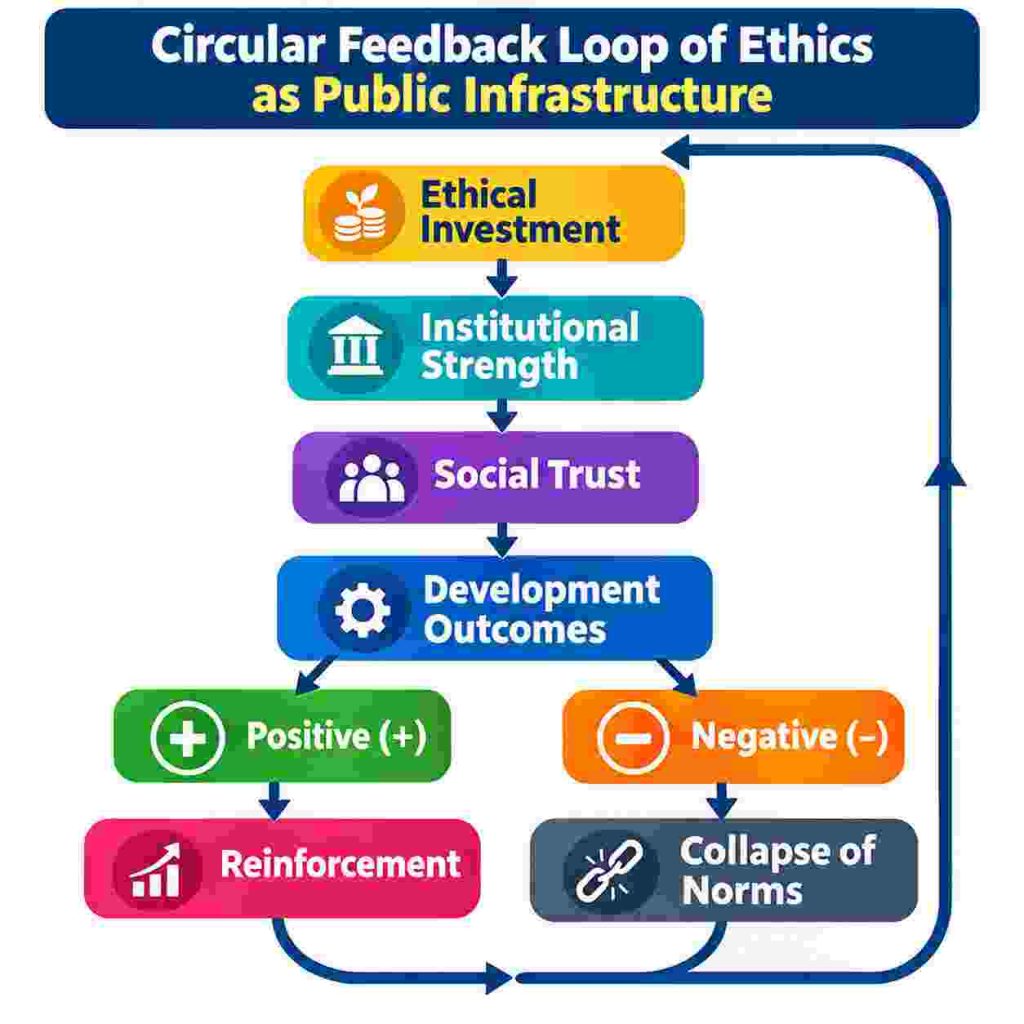
This conceptual figure illustrates the layered relationship between foundational norms, institutional ethics, community trust, and development outcomes, presenting ethics as a self-reinforcing infrastructure for sustainable progress. Positive outcomes strengthen ethical norms, while weak results accelerate ethical decline. The relationship is therefore not linear but circular: ethical conditions influence the quality of institutional and social outcomes, while those outcomes, in turn, influence the ethical conditions that shape what follows.
The Ethics as Public Infrastructure perspective conceptualises ethics as a system analogous to physical infrastructure: vulnerable to decay, requiring deliberate investment, essential to effective societal functioning, and foundational to the functionality and development of other forms of infrastructure. Just as physical infrastructure must be built, maintained and protected, the ethical foundations that support society also require continuous attention, planning and investment.
In simple terms, the figure shows that ethics does not stand apart from development. What people value and practise influences how institutions function, how much communities trust them, and ultimately the outcomes society experiences. When the system produces positive results, those results can reinforce the ethical foundations that support it. When outcomes remain weak, they can contribute to further ethical decline. This creates a feedback loop in which ethical strength can generate conditions that reinforce ethical strength, while ethical weakness can generate conditions that deepen ethical weakness.
A Practical Way of Understanding Ethics
This perspective encourages governments, institutions, educators, development organisations and civil society to look beyond individual acts of misconduct and consider the wider ethical conditions that shape how society functions. It draws attention to the relationships between values, behaviour, institutions, trust and development outcomes, rather than treating each as an isolated issue.
The circular nature of the framework also means that development outcomes are not merely the end point of the process. They can become part of what shapes the ethical environment that follows. Effective institutions, trustworthy relationships and positive development outcomes can reinforce responsible behaviour and strengthen confidence in ethical norms. Conversely, institutional failure, declining trust and poor outcomes can weaken those norms and create conditions in which further ethical deterioration becomes more likely.
It makes ethics more than a matter of personal character. It becomes part of the infrastructure that supports trust, institutional effectiveness, social wellbeing and sustainable development. This is consistent with wider systems thinking in development, where infrastructure is understood as foundational to the delivery of essential services and the achievement of development outcomes. (Nature)
The Core Logic of the Circular Feedback Loop
Strong ethical foundations → stronger institutional ethics → greater trust → better development outcomes → reinforcement of ethical foundations.
Conversely:
Weak ethical foundations → institutional ethical weakness → declining trust → poorer development outcomes → further weakening of ethical foundations.
This is the central proposition of the Circular Feedback Loop of Ethics as Public Infrastructure: ethics can function as a foundational infrastructure whose condition influences the performance of public infrastructure and the systems built around and upon it, while the outcomes of those systems feed back into the ethical environment itself.